
Understanding Network Attack Types and Prevention
Cyber threats are evolving rapidly, from silent passive monitoring to destructive active exploits. Understanding what is a network attack is the first step in building a resilient defense. Join Axclusive ISP in the article below as we explore the essential best practices to safeguard your infrastructure.
What Is a Network Attack?
A network attack occurs when unauthorized parties breach an organization’s infrastructure to compromise the integrity, confidentiality, or availability of its data. These threats are generally categorized by the attacker’s intent. Passive attacks involve intruders monitoring or intercepting sensitive information without leaving a trace or altering the original data. In contrast, active attacks involve intruders who gain unauthorized access to deliberately modify, delete, or encrypt information, directly disrupting business operations and inflicting structural damage on the network environment.
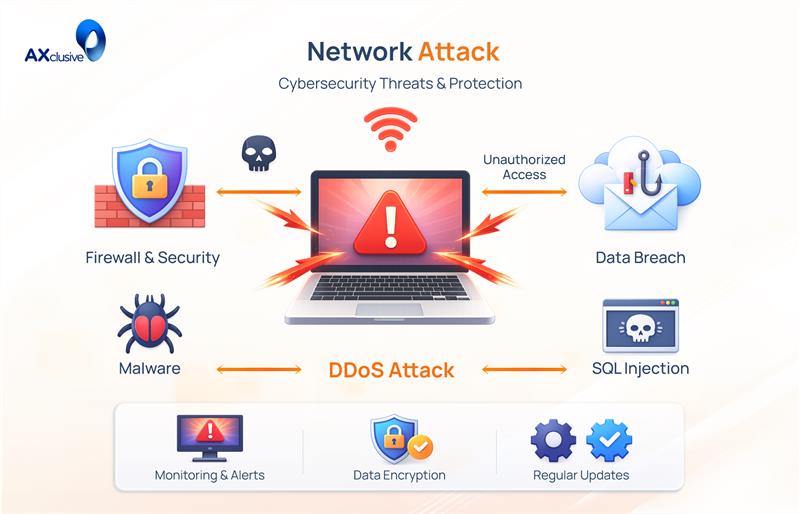
Common Types of Network Attack
Cybersecurity threats are diverse, but they generally follow predictable patterns. Understanding these attack vectors is the foundation of a resilient defense strategy. Below are the most prevalent network security threats and how they impact modern infrastructure.
Passive and Active Threat Models
Network threats are categorized by how the attacker interacts with your data:
- Passive Attacks: Attackers monitor and harvest sensitive data without altering it. Because the original data remains untouched, these intrusions are notoriously difficult to detect.
- Active Attacks: Attackers gain unauthorized access to deliberately modify, delete, or encrypt data. These attempts aim to disrupt business operations and often leave clear signs of tampering.
Configuration Weaknesses
Security misconfigurations are a leading cause of data breaches. These occur when system settings are missing, left at defaults, or incorrectly implemented. Common examples include using weak encryption, leaving insecure services open, or granting excess administrative privileges. Proactive auditing and consistent configuration policies are the primary defenses against these gaps.
DoS and DDoS Incidents
Denial-of-Service (DoS) and Distributed Denial-of-Service (DDoS) attacks aim to shut down network services. A DoS attack overwhelms a target from a single source, while a DDoS attack utilizes multiple systems (often an IoT botnet) to flood the server. The goal is to clog traffic and make the network inaccessible to legitimate users.
Man in the Middle Tactics
In a Man-in-the-Middle (MiTM) attack, a threat actor secretly inserts themselves between two communicating parties. Their objective is to eavesdrop on private conversations, steal credentials, or alter data in transit. Organizations can counter these tactics by enforcing strict end-to-end encryption (VPNs/TLS) and multi-factor authentication.
Buffer Overflow Exploits
This attack exploits memory management flaws in software. By sending more data than a program’s memory buffer can hold, an attacker overwrites adjacent memory, potentially executing malicious code. Prevention involves using modern programming languages and strictly validating the size of all incoming data packets.
Identity Spoofing Methods
Spoofing occurs when an attacker masquerades as a legitimate entity such as an email sender or a resource to deceive users. The end goal is often to install ransomware or steal financial credentials. Defending against spoofing requires robust password policies and strict multi-factor authentication.
Replay Based Threats
A replay attack involves an intruder capturing valid network communication and “replaying” it later to fraudulently repeat a transaction or gain unauthorized access. Because the data itself is legitimate, this bypasses standard authentication. Mitigation involves using unique, time-sensitive session keys for every transaction.
DNS and ARP Manipulation
- DNS Poisoning: Manipulates the Domain Name System to reroute traffic to malicious, fake websites.
- ARP Poisoning: Targets Local Area Networks (LAN) by associating an attacker’s MAC address with a legitimate IP, allowing them to intercept local traffic.Regular patching and the use of static ARP entries are effective countermeasures.
Client Side Exploits
These attacks originate from the victim rather than the server. An attacker uses social engineering or phishing to trick a user into downloading malicious content. Once the device is compromised, it can spread malware throughout the entire corporate network. Employee awareness training is the most effective defense.
Zero Day Exploits
A zero-day attack exploits a software vulnerability unknown to the vendor. Because no patch exists, security teams are left exposed until the flaw is discovered and remedied. Regular, goal-oriented penetration testing is the best practice for finding these hidden weaknesses before malicious actors do.
Network Attack Prevention Best Practices
No security measure is foolproof, but a proactive defense strategy significantly reduces your attack surface. By implementing layered controls and maintaining strict visibility, you can contain threats before they inflict damage. Follow these professional best practices to harden your network infrastructure.
- Segment Your Network: Divide your infrastructure into isolated zones using subnets or Virtual Local Area Networks (VLANs). Segmentation restricts lateral movement; if an attacker compromises one zone, the rest of your network remains protected.
- Deploy Proxy Servers: Do not allow unrestricted internet access. Use transparent proxy servers to monitor outbound connections and ensure they originate from human users rather than automated bots. Whitelisting approved domains further limits exposure to malicious sites.
- Strategically Place Security Devices: Do not rely solely on an edge firewall. Place security controls, including built-in switch and router firewalls, at every junction between network zones. Ensure load balancers and strategic assets reside within a Demilitarized Zone (DMZ) to remain protected by your security apparatus.
- Utilize Network Address Translation (NAT): NAT masks your internal IP addresses from the public internet. By hiding the true identity of your internal hosts, you make it significantly harder for attackers to map your network or target specific machines.
- Maintain Traffic Visibility: Achieve full visibility into internal, inbound, and outbound traffic. Use integrated security solutions that aggregate data from multiple tools to provide context. Automated threat detection is essential for identifying multi-vector attacks that span different systems and user accounts.
- Deploy Deception Technology: Assume that some attackers will bypass your initial defenses. Place digital “decoys” such as fake credentials, files, and network connections—throughout your environment. These traps alert your security team to malicious activity the moment an attacker attempts to interact with them, providing vital intelligence on their methods.
Network security requires layered defenses, constant monitoring, and proactive segmentation. By applying these strategies, you can detect threats early and contain them before they escalate. Axclusive trusts this guide has provided the foundational knowledge needed to strengthen your security posture and protect your digital assets.
⚡ Stay protected from network attack threats. Contact us to secure your infrastructure and keep your business running without disruption. 🚀
Back to blog