
What Is an Ethernet Switch? Types and How It Works
Ethernet switches play an essential part in enabling smooth and efficient communication between devices within a local network. By directing data traffic intelligently, an Ethernet switch helps improve network speed, stability, and overall performance. In this article, Axclusive ISP explores how Ethernet switches work in modern networking environments.
What is an Ethernet switch?
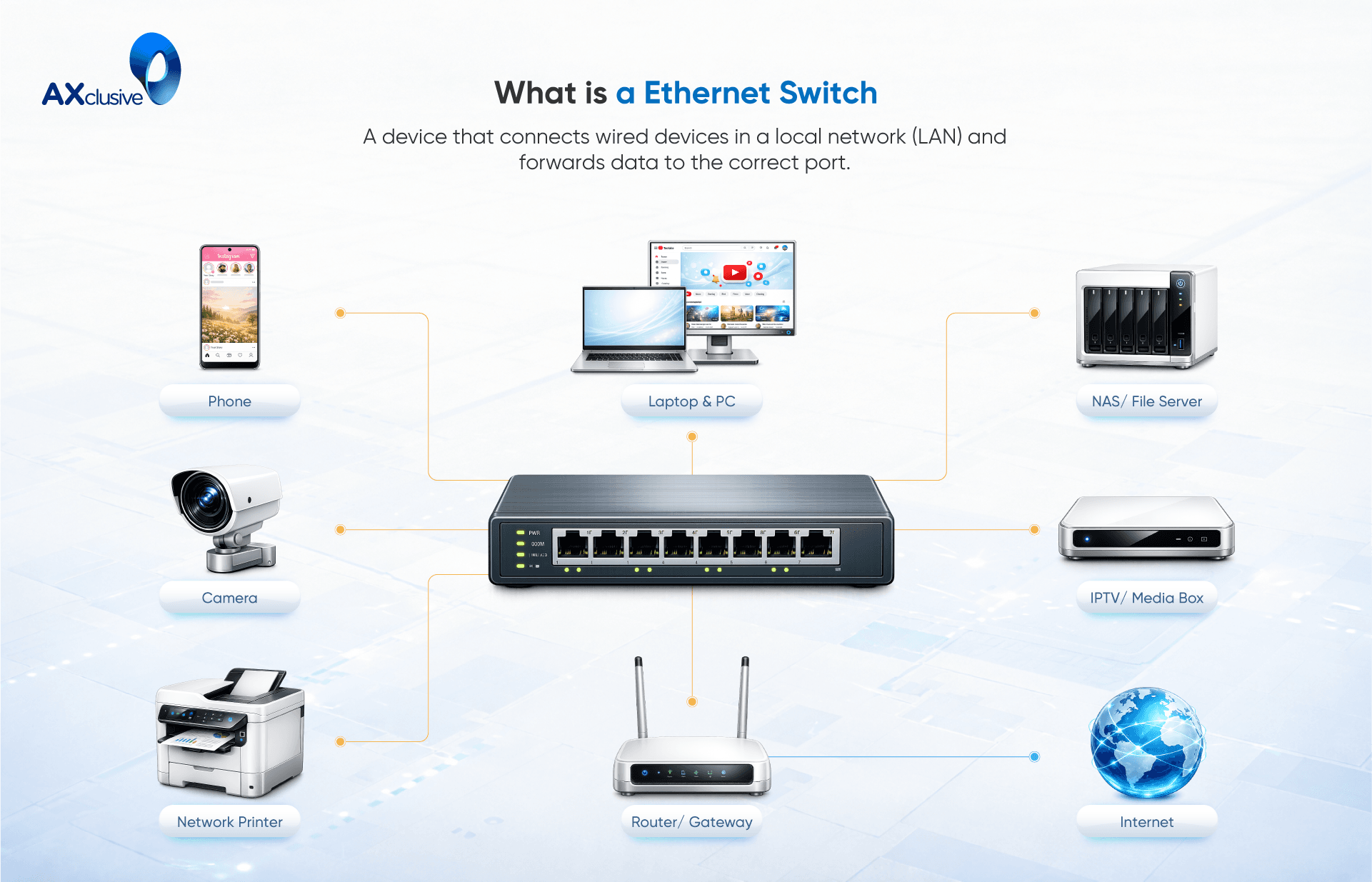
Ethernet switch (formally standardized as IEEE 802.3) is the foundational wired networking technology that enables devices to communicate seamlessly and securely within Local Area Networks (LANs) and enterprise environments. Originally built upon the CSMA/CD (Carrier Sense Multiple Access/Collision Detection) protocol to orchestrate traffic and prevent data packet collisions on shared media, modern Ethernet architecture has evolved to rely on intelligent network switches. These switches actively manage the flow of data across various physical mediums such as twisted pair copper cables and high speed fiber optics supporting highly scalable bandwidth capacities ranging from megabits to terabits per second. Today, Ethernet serves as the ubiquitous, de facto physical and data link infrastructure for global IP based communications.
How do Ethernet switches work
Understanding how an Ethernet switch operates requires a solid grasp of foundational Layer 2 networking concepts. The following terms define the primary functions of modern switching architecture
Packet Switching: This forwarding architecture eliminates the need for dedicated communication circuits. Network hardware dynamically routes data blocks based on destination addresses, enabling multiple connected devices to transmit information concurrently without causing network bottlenecks.
Ethernet Frames: Operating at Layer 2 of the Open Systems Interconnection (OSI) model, frames are the primary data containers traveling between local endpoints. Each frame encapsulates a data payload between a header and a trailer, which include the source and destination Media Access Control (MAC) addresses.
Transparent Bridging: This operation allows a switch to connect different network segments seamlessly. The bridging process requires absolutely zero manual configuration from network administrators and remains completely invisible to the connected end user devices.
Address Learning: As incoming traffic enters a port, the switch inspects the source MAC address of the frame. It dynamically records this address and its corresponding physical port into an internal lookup database known as the Content Addressable Memory (CAM) table.
Traffic Filtering: Once the CAM table is accurately populated, the switch utilizes this data to optimize traffic flow. Instead of broadcasting data everywhere, it intelligently filters and forwards frames exclusively to the specific port associated with the destination MAC address, thereby conserving network bandwidth.
Frame Flooding: If a switch receives a frame targeting a destination MAC address not yet mapped in its CAM table, it must flood the network. The hardware duplicates the frame and transmits it out of every active port except the originating port. Once the target device responds, the switch logs the new address and resumes standard traffic filtering.
Multicast and Broadcast Traffic: Multicast traffic allows a single data stream to be delivered to a specific group of endpoint destinations simultaneously. Broadcast traffic is a specialized variant that delivers frames to every single active node within the Local Area Network (LAN), which is commonly used for dynamic device discovery protocols.
Broadcast and Collision Domains: A broadcast domain encompasses all devices capable of receiving a localized broadcast message without the data traversing a router. A collision domain represents a physical network segment where simultaneous data transmissions can interfere with one another. Switches fundamentally optimize network integrity by isolating collision domains to individual physical ports.
Benefits of Using an Ethernet Switch
Ethernet switches provide a reliable foundation for modern local area networks by improving performance, supporting growth, and ensuring consistent data delivery. Their design allows networks to operate efficiently as the number of users and connected devices increases. The key benefits of Ethernet switching are outlined below.
Optimized Network Throughput and Performance: Modern Ethernet switches isolate collision domains for every individual port and support full duplex transmissions. This completely eliminates localized network congestion, removes data bottlenecks, and ensures maximum throughput with minimal latency.
Dynamic Enterprise Scalability: Switching architecture provides a highly adaptable hardware foundation for business growth. Enterprise deployments leverage modular configurations, allowing administrators to seamlessly integrate additional line cards and high capacity uplink modules as device density increases.
Intelligent Data Routing and Link Auto Negotiation: Switches maximize bandwidth utilization by forwarding frames exclusively to their intended destination utilizing internal Media Access Control (MAC) address tables. They also dynamically auto negotiate the maximum supported link speed for every connected endpoint.
Universal Interoperability and IEEE Compliance: Engineered strictly around IEEE 802.3 protocols, these switches guarantee vendor neutral compatibility. This adherence to global networking standards allows enterprises to confidently integrate legacy devices and advanced infrastructure seamlessly across the Local Area Network (LAN).
Types of Ethernet Switches
Within an enterprise network architecture, Ethernet switches are categorized based on their specific physical location, data processing capabilities, and operational workloads. The standard deployment tiers include:
Access Switches (Edge Layer): Positioned at the exact perimeter of the network, these devices serve as the initial connection point for end user hardware, including desktop workstations, wireless access points, and IP surveillance cameras. They frequently feature Power over Ethernet (PoE) capabilities to supply electrical current directly to these connected peripherals, streamlining physical infrastructure.
Aggregation Switches (Distribution Layer): Functioning as the critical intermediary tier, these switches consolidate uplink traffic originating from multiple access level devices. To manage the resulting high volume data streams, aggregation hardware incorporates advanced Layer 3 routing protocols, deep packet buffers, redundant power supplies, and high capacity multi gigabit uplink ports.
Core Switches (Backbone Layer): Operating as the central nervous system of an enterprise network, core switches interface directly with wide area network (WAN) routers and external internet gateways. Their primary function is rapidly switching massive amounts of aggregated data without bottlenecks. Consequently, they are engineered with stringent High Availability (HA) protocols to prevent catastrophic, network wide outages.
Data Center Switches: Engineered exclusively for high density server environments, these specialized units manage heavy internal communication between servers (east to west traffic) as well as external requests (north to south traffic). They provide extreme fault tolerance and are physically deployed using optimized architectures, such as top of rack or end of row configurations, to support mission critical enterprise applications.
Ruggedized Industrial Switches: While logically functioning at the network edge like standard access switches, these units are physically hardened. They are designed with specialized enclosures and thermal management systems to deliver reliable connectivity in hostile environments, such as manufacturing facility floors, outdoor installations, or locations subject to extreme temperature volatility.
Choosing the Right Ethernet Switch for Your LAN
Selecting the right Ethernet switch is a critical decision for building a secure, scalable, and reliable local area network. Modern Ethernet LANs must support increasing device density, higher traffic volumes, and stricter security requirements. Beyond raw speed, organizations should evaluate how well a switch supports power delivery, device onboarding, traffic control, visibility, automation, and long-term cost management. The following considerations help ensure the Ethernet switch you choose meets both current demands and future growth.
Network Speed Requirements
Ethernet switches are long-term infrastructure investments, often remaining in service for many years. During that time, bandwidth demands continue to grow as more devices and applications rely on the network. Switches should support current performance needs while allowing room for expansion. Selecting models that accommodate higher port speeds and future upgrades helps maintain consistent user experience as traffic increases.
Power and PoE Support
Many modern devices rely on Ethernet not only for data but also for power. Power over Ethernet (PoE) support allows switches to supply power directly to connected devices such as IP phones, cameras, and wireless access points. Choosing switches that support current PoE standards ensures compatibility with newer devices and simplifies cabling by reducing the need for separate power sources.
IoT Device Connectivity
As organizations deploy more connected devices, secure onboarding becomes more complex. Ethernet switches should support automated device identification and onboarding processes. This reduces manual configuration and helps enforce security policies. Support for zero-trust principles ensures that only authorized devices gain access to network resources.
Traffic Prioritization and QoS
Not all network traffic has the same importance. Quality of service (QoS) features allow switches to prioritize critical applications such as voice, video, and business systems over less sensitive traffic. Effective traffic prioritization helps maintain consistent performance even during peak usage periods.
Network Monitoring and Visibility
Visibility is essential for managing and troubleshooting networks. Ethernet switches should offer clear insight into traffic patterns, device status, and potential issues. Features such as centralized management, automated provisioning, and integration with security systems allow administrators to manage networks efficiently and respond quickly to problems.
AI and Machine Learning Features
AI and machine learning capabilities help network teams move from reactive to proactive operations. When integrated into Ethernet LAN management, these features can identify anomalies, predict failures, and automate corrective actions. For best results, switches should integrate with broader network intelligence platforms that combine wired, wireless, and security data.
Budget and Cost Considerations
While Ethernet standards are consistent, total cost of ownership can vary significantly. Beyond hardware costs, organizations should consider licensing fees, support contracts, and operational expenses. Evaluating long-term costs and understanding which features require additional licenses helps avoid unexpected expenses and ensures sustainable network investment.
FAQ
What's better, an Ethernet splitter or a switch?
An Ethernet switch is the better option for networking. It actively manages traffic and delivers data to the correct device, while an Ethernet splitter only divides a physical connection and does not control traffic flow.
Can you use an old router as an Ethernet switch?
Yes, an old router can be used as a switch by disabling routing features and connecting devices through its LAN ports. However, it will not offer the same performance or management features as a dedicated switch.
Is a switch faster than a router?
A switch is generally faster for internal network traffic because it forwards data directly between devices. A router is designed to handle traffic between networks, which involves more processing.
How to convert a router into a switch?
To convert a router into a switch, disable DHCP, assign a static IP within the network range, and connect devices using the LAN ports instead of the WAN port.
An Ethernet switch remains a fundamental component in building efficient and reliable networks. By enabling direct communication between connected devices, it helps optimize traffic flow, reduce congestion, and support scalable network growth. Through this article, we gain a clearer understanding of how Ethernet switches function and why they are essential in modern network environments.