
What Is VXLAN? Virtual Network Explained
As cloud environments and data centers continue to grow, traditional VLANs often struggle to support the scale and flexibility modern networks require. This challenge has led to the rise of VXLAN, a network virtualization technology designed for large-scale environments. But what is VXLAN, and how does it improve network scalability? In this article, Axclusive ISP explores how VXLAN works and how it supports efficient, scalable cloud networking infrastructures.
What is VXLAN?
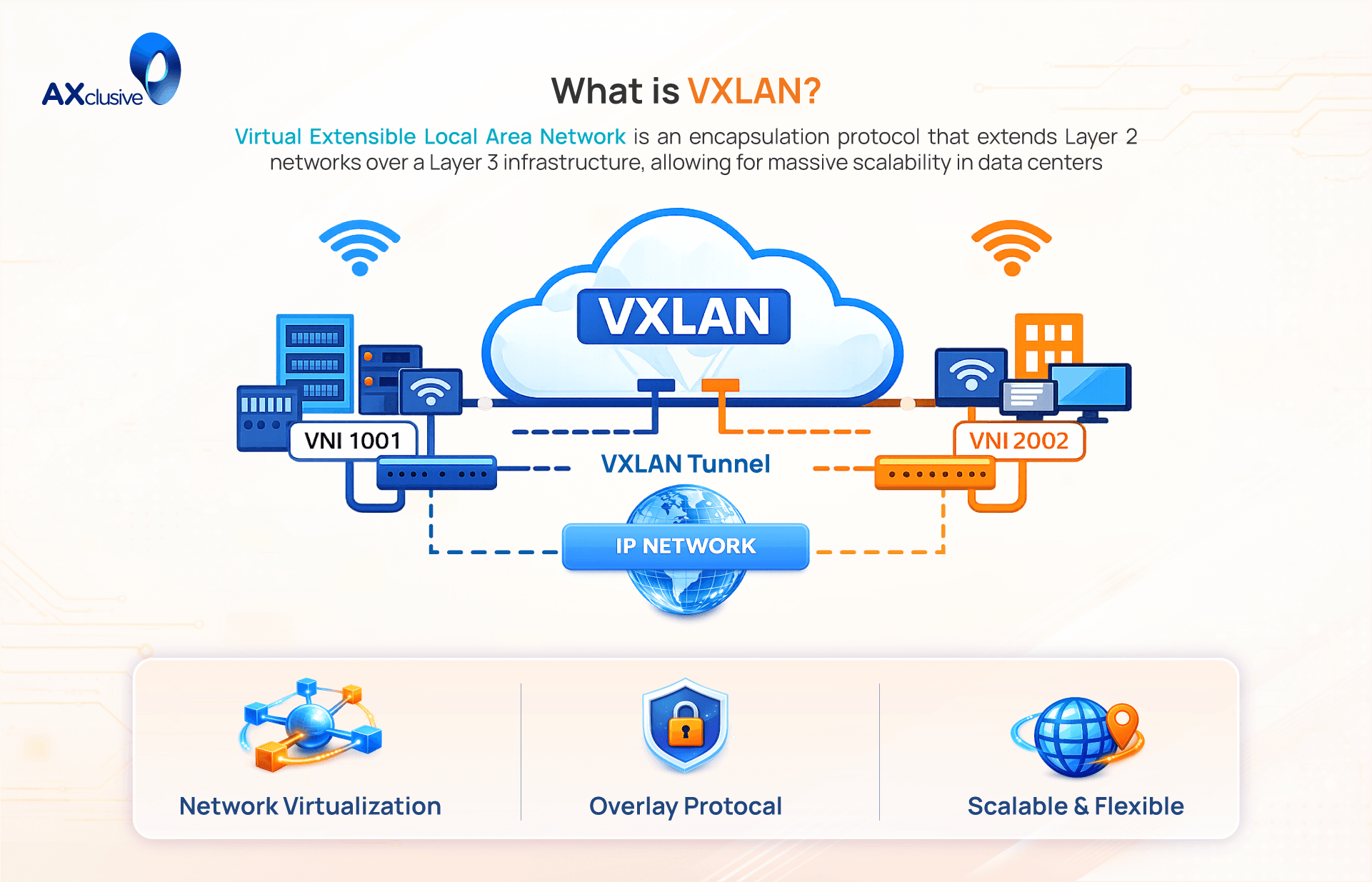
Virtual Extensible LAN (VXLAN) is a robust network virtualization protocol designed to solve the scalability and segment limitations inherent in traditional Local Area Networks (LANs). Standardized by the IETF, VXLAN employs a sophisticated encapsulation technique that wraps Layer 2 Ethernet frames within Layer 4 UDP packets. This process enables the creation of logical overlay networks that can span across a physical Layer 3 IP infrastructure. By utilizing a 24 bit VXLAN Network Identifier (VNI), the technology supports up to 16 million unique virtual segments, far surpassing the 4,096 VLAN limit. This massive scalability makes VXLAN an essential framework for modern multi tenant data centers and cloud environments, allowing distinct organizations to share the same physical hardware while maintaining total traffic isolation and seamless Layer 2 connectivity over geographically dispersed locations.
Want to understand how virtualized networks improve scalability and connectivity across modern infrastructures? Explore our guide on What Is Overlay Network to learn how overlay networks support flexible communication, network segmentation, and cloud-based environments.
How VXLAN Operates in Network Environments
Virtual Extensible LAN (VXLAN) functions as an MAC in UDP encapsulation protocol, allowing Layer 2 connectivity to be tunneled across a standard Layer 3 IP fabric. This architecture creates a logical overlay that decouples virtual workloads from the physical underlay network.
Key Operational Components
- VXLAN Tunnel Endpoint (VTEP): The specialized entity responsible for the encapsulation and decapsulation of traffic. VTEPs function as the entry and exit points of the VXLAN tunnel.
- Hardware VTEPs: Physical switches or routers that handle encapsulation at the hardware level, ideal for integrating bare metal servers.
- Software VTEPs: Located within hypervisors (such as KVM), these manage virtualized workloads directly at the host level.
- VXLAN Network Identifier (VNI): A 24 bit value used to designate specific virtual segments. The VNI ensures that traffic remains isolated within its own logical broadcast domain across the shared physical infrastructure.
The Data Forwarding Process
Encapsulation (Ingress): When an originating node (e.g., VM1) sends an Ethernet frame, the local VTEP intercepts it. The VTEP performs a lookup in its forwarding table using the destination MAC and VNI. It then wraps the original Layer 2 frame inside a VXLAN header, a UDP header, and an outer IP header.
Transport (Underlay): The encapsulated packet is routed across the Layer 3 network like standard IP traffic. The intermediate physical routers only see the outer IP header and are unaware of the encapsulated Layer 2 payload.
Decapsulation (Egress): Upon reaching the destination VTEP, the outer headers are stripped away. The original, unaltered Ethernet frame is then delivered to the target node
Support your growing business with scalable IP Transit solutions that deliver consistent bandwidth and high-speed global connectivity. Reach out to our team for more details.
VXLAN Strengths and Limitations
| Strengths of VXLAN | Architectural Limitations |
|---|---|
| Massive Multitenant Scalability: The 24-bit VNI expands logical segment capacity to over 16 million unique networks, easily accommodating massive cloud data centers. | Encapsulation Overhead: Wrapping frames within UDP headers adds exactly 50 bytes of overhead per packet, which increases bandwidth utilization and often necessitates Jumbo Frame configuration. |
| Dynamic Workload Mobility: Enables seamless live migration of Virtual Machines across physical server boundaries without disrupting active Layer 2 connections or user sessions. | Operational Complexity: Designing and troubleshooting the overlay requires specialized engineering expertise, particularly when managing extensive VTEP deployments and complex routing protocols. |
| Centralized Programmability: Fully compatible with Software Defined Networking (SDN) controllers, allowing for automated provisioning and simplified management of the logical overlay. | Hardware Resource Strain: Processing massive volumes of encapsulated traffic and maintaining exhaustive MAC address tables can exhaust the hardware memory on legacy physical switches. |
| Strict Tenant Isolation: Enforces robust logical boundaries between diverse network segments, guaranteeing that individual tenant traffic remains entirely invisible to unauthorized entities. | Lack of Native Encryption: While the architecture seamlessly integrates with external security frameworks like IPsec, the protocol itself does not natively encrypt data payloads. |
VXLAN Deployment Models
The specific model chosen for a VXLAN deployment is defined by the location of the VXLAN Tunnel End Point (VTEP). The VTEP is the device responsible for encapsulation and decapsulation, and its placement determines how traffic enters and exits the overlay network. The decision depends on the network's scale, the type of workloads (virtual vs. physical), and the need for external connectivity.
Host-Based VXLAN Deployment
In this model, the VTEP functionality resides within the hypervisor on the server host itself, typically as part of a virtual switch. Encapsulation and decapsulation are performed in software before the traffic is placed on the physical network. This approach is ideal for environments with high concentrations of virtual machines (VMs), as it allows for maximum flexibility and mobility. East-west traffic between VMs on different hosts is handled efficiently at the server edge, and the physical network only needs to provide simple IP transport.
Gateway-Based VXLAN Deployment
With this approach, the VTEP is a hardware-based function on a physical network device, such as a top-of-rack switch or a spine router. This device, often called a VXLAN gateway, handles the encapsulation and decapsulation for all connected, non-VXLAN-aware endpoints, like bare-metal servers or traditional VLANs. The primary use case for this model is to provide the critical on/off-ramp between the VXLAN overlay and the external, non-VXLAN world, enabling north-south routing and connectivity.
Hybrid VXLAN Architecture
A hybrid architecture combines both host-based and gateway-based deployments within the same network, which is the most common model in modern data centers. In this design, software VTEPs on the hypervisors handle the highly efficient east-west traffic between virtual machines. Simultaneously, hardware-based VXLAN gateways provide high-performance north-south routing, connecting the virtualized environment to physical servers, legacy networks, and the internet. This approach offers the optimal balance of flexibility, scalability, and performance.
VXLAN is the definitive solution to the scaling challenges of traditional networks. By providing massive scale and workload mobility, it has become indispensable for modern cloud and data center environments. This guide from Axclusive provides the foundational knowledge needed to help you design and deploy a more scalable and resilient network architecture.
Contact us today to learn more about what is VXLAN and how VXLAN can help scale and simplify modern network virtualization.